
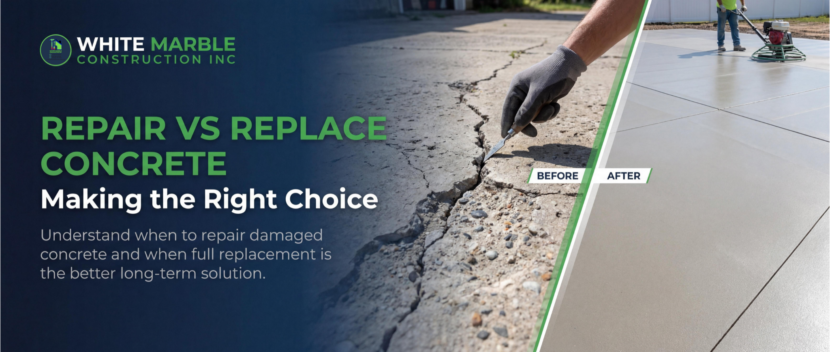
Concrete Repair vs Replacement: Which is the Best Option?
- By Admin-WMC
- May 5, 2026
- 518
- News Updates
Technical Guide
When faced with concrete issues, it’s crucial to systematically analyze material conditions, levels of deterioration, and long-term performance needs to determine whether to repair or replace concrete. The decision hinges on whether the structural integrity of the existing concrete has been compromised or if the damage is irreversible.
Concrete Repair is suitable for localized damage when the overall system remains stable. In contrast, Concrete Replacement is necessary when there’s a significant deterioration in structural performance, load-bearing capacity, or long-term reliability.
Assessment Criteria
The decision-making process begins with a technical review of several key factors:
Severity of Cracking: Assess whether cracks are superficial or structural. Minor surface cracks may be deemed repairable, while deep cracks or displacements often indicate structural failure.
Load Conditions: Concrete elements under constant or heavy loads require higher performance standards. If repairs can’t restore necessary strength, replacement is the better option.
Underground and Soil Features: Issues like poor compaction, settlement, or poor drainage can cause repeated damage. In such cases, replacement addresses root problems that repairs might miss.
Long-Term Performance: The age and existing condition of concrete are critical. Older systems subject to ongoing wear may not benefit from repairs and could need complete replacement.
Concrete Repair: Implementation and Results
Concrete repair focuses on restoring functionality and extending service life without removing the existing structure. It is best suited for limited damage where the underlying structure is still stable. Common techniques include crack sealing, structural injection, surface restoration, and bonding applications, which enhance durability and repair surface integrity.
Key Benefits:
- Shorter project duration
- Lower costs
- Less disruption
However, the effectiveness of repairs is contingent on the stability of the existing substrate. Underlying issues may reduce the efficacy of repair efforts.
Concrete Replacement: Application and Structural Reliability
Concrete replacement involves the complete removal of deteriorated material and installation of new concrete. This method is essential when there is notable loss of structural integrity or when repair is infeasible.
Advantages:
- Completes the correction of underlying issues such as subgrade instability and drainage problems.
- Provides a reliable and consistent structural solution that meets current performance requirements.
While replacement carries higher upfront costs and longer execution times, it delivers greater reliability and mitigates risks of future failures associated with compromised concrete systems.
Performance Comparison
Concrete repair conserves costs while extending the life of existing structures, particularly for non-structural damage. Conversely, concrete replacement ensures a higher performance level by addressing defects and providing a more robust structural system optimal for critical applications emphasizing safety and durability.
The choice between repair and replacement should align with whether the goal is immediate restoration or long-term structural revitalization.
Cost and Lifecycle Considerations
Typically, repairs are less expensive and quicker to complete, ideal for projects constrained by budget and disruption. In contrast, replacement, although higher in initial cost due to demolition and new material requirements, often results in reduced maintenance and lower long-term expenses.
A lifecycle cost approach is advisable, considering all costs incurred over time, rather than focusing solely on initial expenses.
Risk Evaluation
Repairs can be riskier if underlying problems remain unaddressed, leading to recurring damage. Replacement mitigates these risks by addressing both visible and hidden structural deficiencies, promising a more stable and predictable long-term solution.
Recommended Approach
A professional assessment is essential to identify the most suitable solution. Factors like structural condition, environmental exposure, usage needs, and long-term performance expectations must all be considered.
White Marble Construction Inc. employs a thorough assessment procedure to determine the most technically warranted option, aiming for an effective balance of performance, cost, and lifespan.
Both concrete repair and replacement serve crucial roles in construction maintenance and structural restoration. Repairs are ideal for localized, non-structural damage, offering economical solutions. When faced with advanced deterioration or structural failure, replacement provides long-term reliability and performance.
Ultimately, the best solution is identified through careful evaluation tailored to the specific project needs.

Add Comment